
DePIN (Decentralized Physical Infrastructure Networks) is reshaping real-world infrastructure with token incentives, community-run hardware, and new revenue models. Learn what’s driving 2026’s DePIN momentum, top projects, risks, and how businesses can participate.
Intro — quick hook
DePIN — short for Decentralized Physical Infrastructure Networks — is moving fast from crypto buzzword to real-world infrastructure: think community-run wireless networks, decentralized storage farms, crowd-sourced vehicle telemetry, and distributed compute that are funded and governed by token incentives. In 2026 the sector is seeing renewed private capital, clearer product-market fit signals, and growing adoption in telecom and IoT verticals.
Background context: what is DePIN?
DePIN refers to systems that coordinate physical hardware (hotspots, sensors, storage devices, compute rigs) using blockchain-native economic incentives. Instead of centralized companies buying and operating infrastructure, DePINs reward independent operators (node hosts) with tokens or fees for offering coverage, storage, compute, or sensor data. This model aims to lower capital barriers, accelerate deployment, and create permissionless growth for infrastructure that is traditionally expensive and centralized.
Latest (January 2026) headlines and market signals
- Private capital continues to flow into DePIN startups even while public-market valuations remain subdued; 2025 saw meaningful seed and Series A activity, signaling sustained long-term investor conviction.
- Market maps show a sizable DePIN market cap across wireless, storage, compute and mapping projects; some trackers estimate the aggregated DePIN sector market cap in the low double-digit billions as of Jan 2026.
- Industry press and research note growing telecom interest in DePIN concepts for optimizing 5G roaming, fraud-proofing infrastructure, and improving edge compute distribution — signaling potential enterprise partnerships ahead.
- Analysts and newsletters emphasize that 2026 will reward measurable network metrics (revenue, uptime, real-world demand) rather than speculative node counts. Projects that show paid usage and reliable SLAs are gaining credibility.



Why DePIN matters right now
- Real utility, not just speculation — DePINs deliver concrete services (connectivity, storage, mapping) that enterprises and consumers can buy, creating a path from tokens to recurring revenue.
- Capital efficiency & rapid rollout — By aligning incentives for independent hosts, DePINs reduce upfront capex and let networks scale incrementally.
- Interplay with AI & Edge — DePIN hardware at the edge complements AI workloads, enabling distributed inference, sensor data collection, and latency-sensitive applications — attracting funds focused on AI + infra.
Top DePIN categories & notable projects (brief)
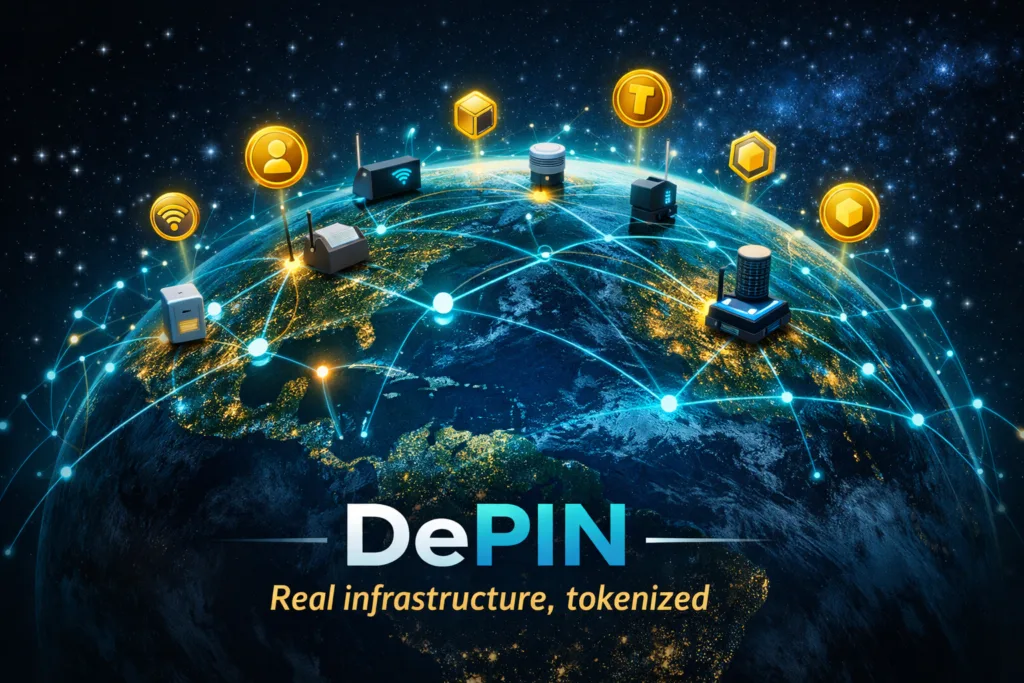
- Decentralized wireless / IoT — community hotspots providing LoRa/5G-style coverage (well-known examples in the space provide the model for others).
- Decentralized storage — large-scale distributed archives and retrieval networks with tokenized incentives.
- Edge compute & GPUs — marketplaces for underused compute power for AI/ML workloads.
- Mapping & sensing — crowd-sourced geolocation and environmental sensors that monetize data.
Opportunities for businesses and developers
- Integrate with DePIN APIs to reduce infrastructure costs (for telemetry, storage, or edge compute).
- Build hybrid products that combine DePIN-sourced data with traditional cloud services to improve resilience and lower marginal costs.
- Explore partnerships: telcos and utilities may adopt DePIN elements for lower-cost coverage in underserved regions.
Risks and red flags
- Regulatory uncertainty — hardware networks face local telecom, spectrum, and data regulations that vary by jurisdiction.
- Token economics & sustainability — many projects still need to prove long-term rewards for hosts versus token inflation.
- Reliability & SLAs — decentralized nodes must meet uptime and performance expectations for enterprise adoption; projects lacking measurable service metrics will struggle.
Actionable takeaways
- If you’re a developer: test integration with a DePIN project’s devnet or sandbox to measure performance and costs.
- If you’re an investor: prioritize projects with verified revenue streams, growing paid usage, and transparent host economics.
- If you’re an enterprise: pilot DePIN for non-critical workloads (backup storage, out-of-band telemetry) before full production adoption.
Suggested authoritative sources (for further reading)
- Messari (DePIN research & newsletters).
- CertiK (explainers and security perspectives on DePIN).
- CoinGecko (DePIN category market overview & token metrics).
- CoinDesk (industry funding and ecosystem announcements).
- CryptoNews / market coverage (DePIN market maps and analyst commentary).
Article-specific disclaimer:
This article summarizes publicly reported market signals, research and news about DePIN as of January 2026. It is intended for informational purposes only and should not be taken as financial, legal, or technical advice. Verify regulatory constraints and project-specific data before deploying hardware or investing resources.
AI-generation & accuracy disclaimer:
This article was drafted with the assistance of an AI. While we use current sources to inform the content, AI-generated text can include errors or omissions. Please double-check critical facts, dates, and figures against primary sources before relying on them.
🚗 Kia Seltos New Variants 2026: Feature Upgrades, Premium Trims & Market Impact

Explore the latest Kia Seltos new variants in 2026, including GTX(O), X-Line(O), new features, pricing insights, and future SUV trends in India. Google Pixel 10 Pro 2026: AI Powerhouse, Camera King & The Future of Android Flagships 📰 Introduction: Kia Seltos Expands Its Lineup in 2026 The 2026 update of Kia Seltos new variants signals…
📱 Google Pixel 10 Pro 2026: AI Powerhouse, Camera King & The Future of Android Flagships
Google Pixel 10 Pro 2026 brings advanced AI features, Tensor G5 chip, powerful cameras, and smart updates. Explore latest news, specs, and trends in India. Royal Enfield Guerrilla 450 (2026): Apex Variant Launch Signals a Bold Streetfighter Evolution 📊 Google Pixel 10 Pro 2026: Latest News & Market Trends The Google Pixel 10 Pro continues…
🏍️ Royal Enfield Guerrilla 450 (2026): Apex Variant Launch Signals a Bold Streetfighter Evolution
The Royal Enfield Guerrilla 450 gets a major 2026 update with a new Apex variant, improved features, and aggressive pricing. Here’s a complete breakdown of specs, variants, and market impact Renault Duster 2026 Launched in India: Pricing, Features, Hybrid Tech & Market Disruption Analysis The Royal Enfield Guerrilla 450 has officially received its biggest update…










Join Us on Social Media!
Stay updated with the latest from EasyBuzz. Connect with us: