
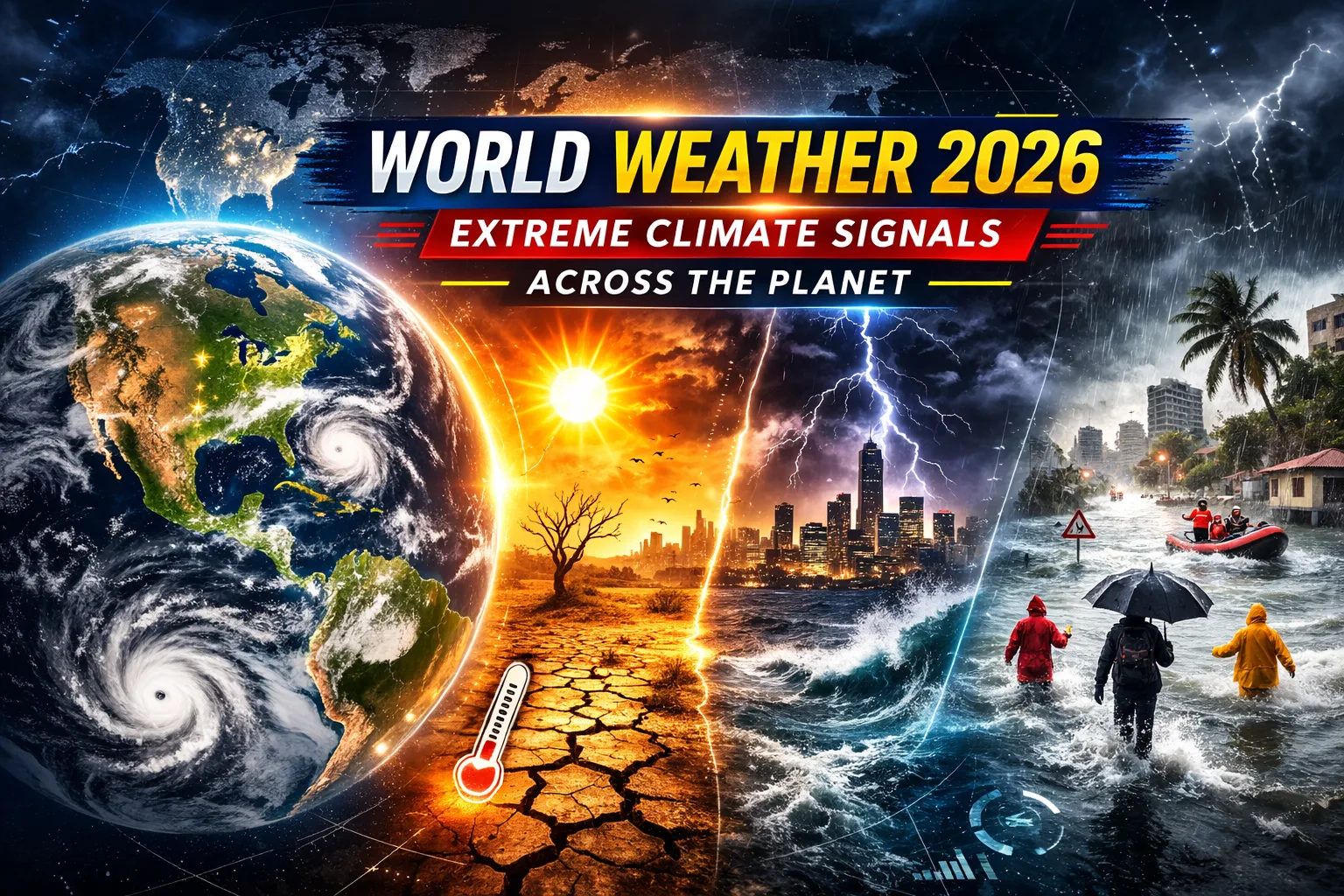
Explore the latest world weather trends in 2026, including extreme heatwaves, storms, and the possible return of El Niño. Discover how global climate patterns are reshaping weather worldwide.
T20 Cricket World Cup 2026: Semi-Final Showdowns, Tactical Battles, and the Race to the Global Crown
World Weather in 2026: Extreme Events and Climate Signals Shaping the Global Forecast
The world weather pattern in 2026 is revealing a complex and rapidly evolving climate story. From unusual heatwaves and destructive storms to shifting ocean cycles such as El Niño and La Niña, meteorologists are observing a world where extreme weather is becoming more frequent and more intense.
Recent global reports indicate that climate-driven events — including floods, wildfires, storms, and heatwaves — are occurring across multiple continents simultaneously, highlighting the growing volatility of the planet’s weather systems.
As 2026 unfolds, the interplay between ocean temperatures, atmospheric circulation, and climate change is shaping a new era of world weather unpredictability.
The Return of El Niño: A Potential Global Weather Disruptor
One of the most significant drivers of world weather is the El Niño–Southern Oscillation (ENSO) cycle.
Climate agencies report that the recent La Niña phase is weakening, with conditions expected to transition toward neutral and possibly develop into El Niño later in 2026.
El Niño events typically bring major weather shifts worldwide, including:
- Severe droughts in parts of Asia and Australia
- Heavy rainfall and floods in South America
- Increased global temperatures
- Stronger storm seasons in some regions
Scientists warn that if El Niño forms during an already warming climate, global temperatures could rise to record-breaking levels again.
Extreme Weather Events Already Shaping 2026
The early months of 2026 have already witnessed several remarkable weather developments across the globe.
Heatwaves and Early Summer Conditions
Parts of southern India experienced unusually high temperatures early in the year, with some regions nearing 40°C and extreme UV radiation levels, prompting heatwave alerts.
Such early heat signals suggest that some regions could experience longer and more intense summers.
Storms and Flooding in Europe
Major winter storms have battered parts of Europe, including Storm Kristin, which caused billions of euros in damages and widespread power outages across Portugal, Spain, and neighboring countries.
These storms highlight the growing intensity of mid-latitude weather systems.
Heavy Rainfall and Flood Risk in South America
In Peru, coastal El Niño conditions have already produced heavy rains and floods affecting agriculture and infrastructure, with thousands of people impacted.
Weather officials warn that the rainfall could intensify in the coming months.
Global Temperature Trends: A Warming Planet
Climate monitoring agencies confirm that global temperatures remain historically high.
- January 2026 ranked among the warmest on record worldwide.
- The last several years have been the hottest period ever recorded on Earth.
Scientists attribute this warming trend to a combination of greenhouse gas emissions and climate oscillations like El Niño.
Higher temperatures also increase the probability of extreme events such as heatwaves, droughts, and intense rainfall.
Why Extreme World Weather Is Becoming More Common
Climate researchers identify several major drivers behind the increase in extreme weather:
1. Rising Global Temperatures
Warmer air holds more moisture, leading to heavier rainfall and stronger storms.
2. Ocean Temperature Changes
Sea-surface temperatures influence global circulation patterns that drive monsoons, hurricanes, and jet streams.
3. Urbanization and Land-Use Changes
Rapid urban growth can intensify heat islands and increase flood risk.
4. Climate Change Feedback Loops
Melting ice, warming oceans, and changing vegetation patterns can amplify global weather shifts.
Extreme weather is now considered one of the most serious long-term global risks, especially for developing countries with limited resources to adapt.
What Experts Expect for the Rest of 2026
Meteorologists and climate agencies forecast several possible developments for world weather in the coming months:
- Increased risk of heatwaves across Asia and Europe
- Stronger rainfall events and flooding in tropical regions
- Intensified hurricane and cyclone seasons depending on ocean conditions
- Continued warming trends driven by climate change
The combination of natural climate cycles and human-driven warming means weather systems are becoming more complex and harder to predict.
Global Response: Improving Forecasting and Early Warnings
To reduce the risks of extreme weather, scientists and governments are investing in:
- Advanced satellite monitoring
- AI-driven weather prediction models
- Global early warning systems
- Climate-resilient infrastructure
Experts stress that improved forecasting and disaster preparedness will be crucial for protecting communities from future climate impacts.
Conclusion
The story of world weather in 2026 reflects a planet experiencing rapid environmental change. From potential El Niño developments to record-warm temperatures and intensifying storms, the global climate system is entering a more volatile phase.
Understanding these patterns and strengthening climate resilience will be essential as societies adapt to the new realities of global weather.
Disclaimer: The information presented in this article about world weather is intended for general informational and educational purposes only. While efforts are made to ensure that the data and analysis are accurate and up to date, weather conditions, forecasts, and climate developments can change rapidly due to natural atmospheric variations and updated scientific observations. This content may include interpretations and analysis based on publicly available meteorological reports and climate research. It should not be considered official weather advice, emergency guidance, or a substitute for information provided by national meteorological agencies or disaster management authorities. Any images used are for illustrative or editorial purposes only and may not represent actual weather events in specific locations. Readers are encouraged to consult official weather services and government advisories for real-time forecasts, safety instructions, and emergency updates.The publisher is not responsible for any actions taken based on the information presented in this article.
Liverpool vs Man City: City Win 3-0 at Anfield in Style Now
Liverpool vs Man City ends 3-0 at Anfield as Haaland, Doku and Cherki score to keep Manchester City top of the Premier League table this season. Shakti Peethas in 2026: Latest News and Sacred Sites – easybuzz.in Liverpool vs Man City: City Deliver a Statement Victory Manchester City produced an impressive second-half display to beat…
Shakti Peethas in 2026: Latest News and Sacred Sites

Explore the latest Shakti Peethas news in 2026, sacred temples, Hindu mythology, Navratri rituals, pilgrimage updates and travel tips for devotees. West Indies vs India: Gill Powers Historic ODI Chase Shakti Peethas in 2026: Latest News, Rituals and Sacred Sites The latest developments surrounding Shakti Peethas highlight the continuing importance of India’s sacred goddess temples,…
West Indies vs India: Gill Powers Historic ODI Chase
West Indies vs India saw Shubman Gill smash 223 as India chased 406 to win the second ODI by eight wickets and seal the series 2-0 in Guwahati. Caribbean Premier League 2026: Falcons Make History West Indies vs India: Gill Leads Historic Run Chase The West Indies vs India ODI series took another dramatic turn…










Join Us on Social Media!
Stay updated with the latest from EasyBuzz. Connect with us: