


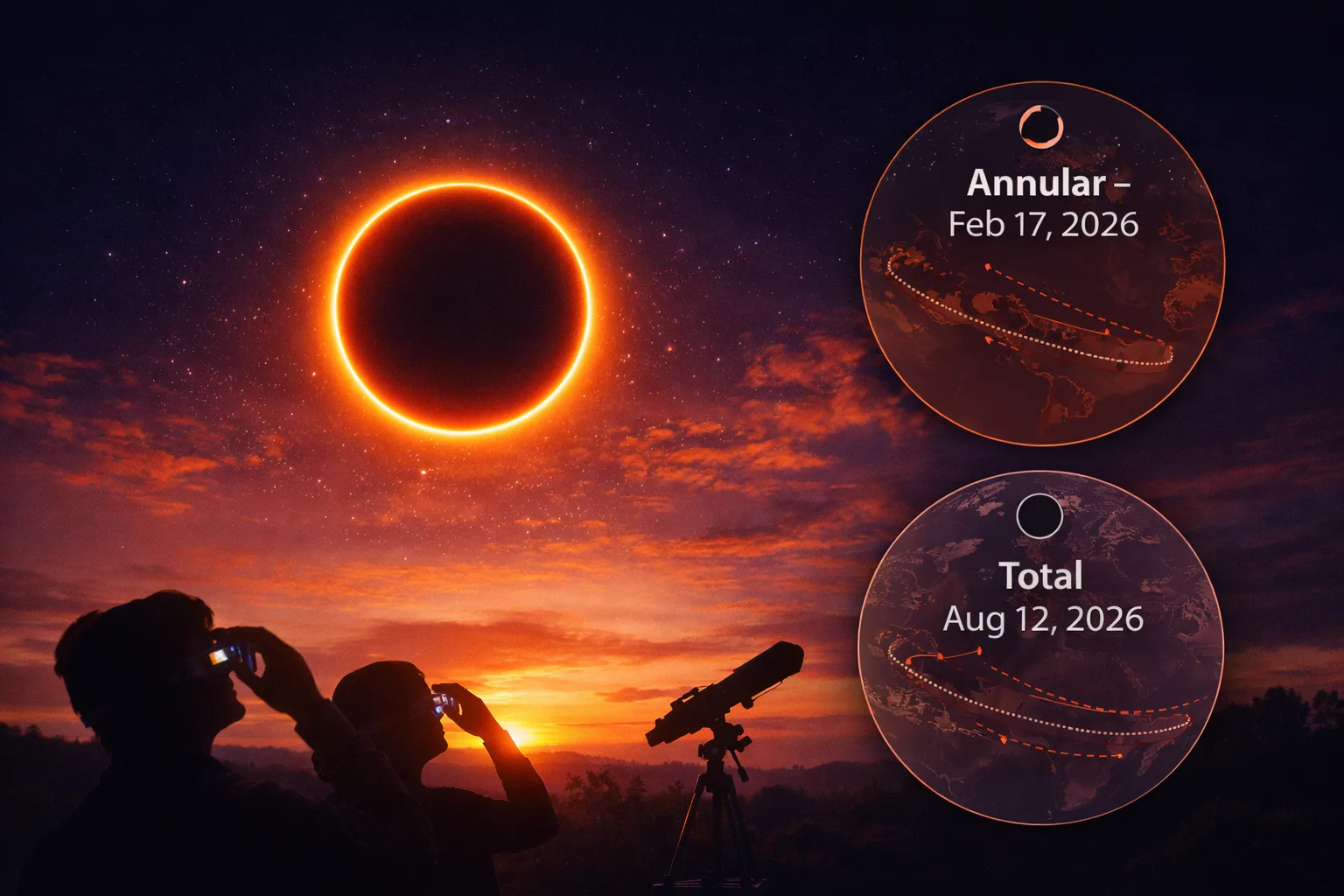
Discover the 2026 solar eclipse events — from the rare “ring of fire” annular eclipse to where and how you can safely view the phenomenon, backed by expert insights and global visibility patterns.
Hyundai Verna Facelift Interiors — What Leaked Photos Reveal About the 2026 Cabin Upgrade
Solar eclipse
A solar eclipse occurs when the Moon passes between Earth and the Sun, partially or fully blocking the Sun’s light from parts of the world. In 2026, skywatchers and science enthusiasts have two remarkable solar eclipse events to anticipate. The first — an annular solar eclipse on 17 February 2026 — will create a dramatic “ring of fire” effect as the Moon covers the centre of the Sun but leaves a glowing ring around its edges. This rare spectacle will be visible in full annularity mainly from Antarctica, with partial views stretching across southern Africa, parts of South America and nearby ocean regions. Later in the year, a total solar eclipse on 12 August 2026 will sweep across the Arctic, Greenland, Iceland, northern Spain, and parts of Portugal, where the Moon completely obscures the Sun in a brilliant totality path. Solar eclipses are part of predictable eclipse seasons and occur in pairs with lunar eclipses due to the orbital geometry of the Earth–Moon–Sun system. These celestial alignments offer not just a visual marvel but opportunities for scientific study and public engagement.
Key Solar Eclipse Highlights in 2026
1. Annular “Ring of Fire” Eclipse — 17 February 2026
The first solar eclipse of 2026 will be annular, meaning the Moon will appear slightly smaller than the Sun and leave a bright ring visible from within the path of annularity. Although full annularity is limited mostly to Antarctica, regions of southern Africa, South America and surrounding waters will see a partial eclipse.
2. Why It’s Called a “Ring of Fire”
During annular eclipses, the alignment creates a fiery ring as the Sun’s edges remain visible around the Moon’s silhouette. This effect occurs because the Moon is near its apogee and doesn’t completely cover the Sun’s disc.
3. Eclipse Viewing Safety
Looking directly at the Sun — even during a partial eclipse — is unsafe without proper eye protection. Observers should use certified solar eclipse glasses or indirect projection methods to avoid eye damage.
4. Eclipse Seasons & Pairing with Lunar Eclipses
Solar eclipses tend to occur in pairs with lunar eclipses during what astronomers call eclipse seasons. In 2026, the February annular eclipse pairs with a total lunar eclipse in early March, while the August total solar eclipse pairs with a partial lunar counterpart later in the month.
5. Global Interest & Cultural Significance
Solar eclipses capture worldwide attention not only from scientists but also from public observers, photographers, educators, and astronomers who use these events to engage communities and expand interest in space science.
Disclaimer : This article and accompanying feature image are created for informational and educational purposes only. The details regarding the solar eclipse events in 2026 are based on publicly available astronomical forecasts and may be subject to refinement as updated calculations are released by official space agencies and observatories. Eclipse timings, visibility zones, and viewing conditions can vary depending on geographic location and atmospheric factors. Readers are strongly advised to consult official astronomical organizations, local observatories, or certified eclipse maps for precise regional visibility details. The feature image is a digitally generated conceptual illustration designed to visually represent an annular “ring of fire” solar eclipse and related 2026 events. It is not an official NASA, ESA, or space agency photograph. Always use certified solar viewing glasses or approved projection methods when observing any solar eclipse. Looking directly at the Sun without proper protection can cause permanent eye damage.




Shakti Peethas in 2026: Latest News and Sacred Sites

Explore the latest Shakti Peethas news in 2026, sacred temples, Hindu mythology, Navratri rituals, pilgrimage updates and travel tips for devotees. West Indies vs India: Gill Powers Historic ODI Chase Shakti Peethas in 2026: Latest News, Rituals and Sacred Sites The latest developments surrounding Shakti Peethas highlight the continuing importance of India’s sacred goddess temples,…
West Indies vs India: Gill Powers Historic ODI Chase
West Indies vs India saw Shubman Gill smash 223 as India chased 406 to win the second ODI by eight wickets and seal the series 2-0 in Guwahati. Caribbean Premier League 2026: Falcons Make History West Indies vs India: Gill Leads Historic Run Chase The West Indies vs India ODI series took another dramatic turn…
Caribbean Premier League 2026: Falcons Make History
Caribbean Premier League 2026 ends with Antigua & Barbuda Falcons winning their maiden title after beating Jamaica Kingsmen by eight wickets in Barbados. Japan vs India T20I: Historic Clash Set for Sano Caribbean Premier League 2026: A Historic Finish The Caribbean Premier League has wrapped up another memorable season, and the 2026 edition has produced…











1 Comment
[…] Solar Eclipse 2026 — Ring of Fire, Visibility Zones & Why This Celestial Event Matters […]