
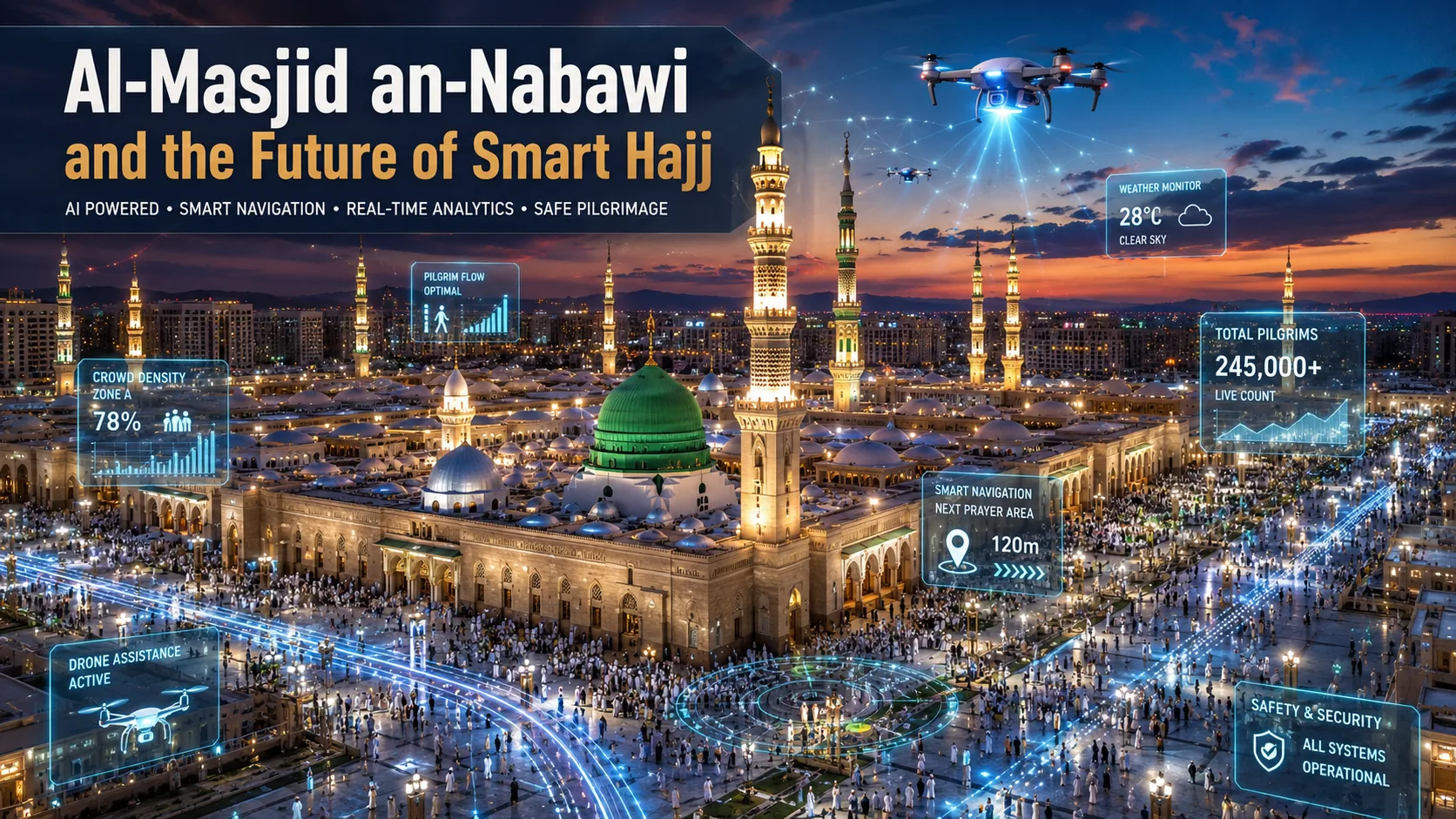
Al-Masjid an-Nabawi adopts AI systems, smart pilgrim services, and advanced Hajj technology as Medina prepares for Hajj 2026.
Field Hockey’s New Global Rivalries Shape 2026 Era
Al-Masjid an-Nabawi is witnessing one of the most technologically advanced transformations in its modern history as Saudi Arabia intensifies preparations for Hajj 2026. The Prophet’s Mosque in Medina, already one of the most spiritually significant destinations in the Islamic world, is now becoming central to the Kingdom’s expanding smart pilgrimage strategy.
Recent developments surrounding Al-Masjid an-Nabawi reveal how artificial intelligence, digital infrastructure, and advanced crowd-management systems are increasingly shaping the Hajj and Umrah experience for millions of pilgrims arriving from across the globe.
Saudi authorities have introduced new AI-powered monitoring systems, drone-assisted services, facial-recognition security operations, multilingual guidance platforms, and smart accommodation technologies designed to improve pilgrim safety and operational efficiency during the 2026 pilgrimage season. The modernization effort reflects Saudi Arabia’s broader Vision 2030 initiative focused on expanding religious tourism while modernizing public infrastructure.
One of the most significant changes this year involves electronic systems capable of tracking pilgrim movement throughout key holy sites connected to Hajj operations. Saudi officials say the systems are intended to regulate entry and exit patterns, reduce overcrowding risks, and improve emergency response coordination during peak pilgrimage periods. Smart signage and digital guidance systems are also being installed to assist worshippers moving between Medina, Mina, and other pilgrimage zones.
The increased use of AI and predictive analytics comes as authorities anticipate another major surge in pilgrim arrivals. Medina has already experienced sustained growth in religious tourism over recent years, particularly around Al Rawdah Al Sharifa inside Al-Masjid an-Nabawi. Saudi figures previously showed visitor numbers reaching millions annually, forcing planners to redesign movement systems and visitor scheduling operations around the mosque complex.
Technology is now being integrated into nearly every stage of the pilgrimage experience. Reports linked to Hajj 2026 preparations indicate that Saudi authorities are deploying aerial drones for logistics and healthcare support, while AI-driven surveillance systems monitor crowd density in real time. These systems help security teams identify congestion points before they escalate into safety concerns.
Another major focus this year is multilingual communication. The Arafat sermon for Hajj 2026 is expected to be broadcast in more than 30 languages, reflecting Saudi Arabia’s growing effort to improve accessibility for international pilgrims visiting Al-Masjid an-Nabawi and other holy sites. Digital religious guidance initiatives connected to the Two Holy Mosques are also expanding rapidly through online platforms and AI-supported translation services.
Saudi Arabia has also expanded volunteer and public-service programs connected to the Prophet’s Mosque during the pilgrimage season. New volunteer opportunities around Masjid an-Nabawi are being introduced to support crowd guidance, accessibility assistance, and worshipper services as visitor numbers continue increasing.
The developments surrounding Al-Masjid an-Nabawi are not limited to technology alone. The mosque remains deeply connected to global Islamic identity and scholarship. Earlier this year, Saudi authorities appointed Sheikh Saleh Al-Maghamsi as an imam of the Prophet’s Mosque, drawing major attention across the Muslim world. His appointment reinforced the mosque’s continuing role as a spiritual and intellectual center for millions of worshippers.
Despite the rapid modernization taking place around Medina, the spiritual atmosphere of Al-Masjid an-Nabawi continues to define the pilgrim experience. Worshippers visiting the Green Dome and Rawdah prayer area still describe the mosque as one of the most emotionally powerful destinations in Islam. For many pilgrims, Medina represents a deeply personal connection to the life and legacy of Prophet Muhammad.
At the same time, the expansion of smart infrastructure around Al-Masjid an-Nabawi reflects a broader shift in how large-scale religious gatherings are managed globally. Pilgrimage operations increasingly depend on predictive analytics, digital surveillance, healthcare automation, and real-time communication systems capable of supporting millions of visitors within limited geographic spaces.
Supporters of the modernization efforts argue that AI systems significantly improve safety, especially during periods of extreme heat and high crowd density. Critics, however, continue raising concerns about balancing technological expansion with the spiritual simplicity traditionally associated with pilgrimage.
Still, Saudi Arabia appears committed to accelerating innovation across the Hajj ecosystem. Analysts believe Al-Masjid an-Nabawi will remain one of the central testing grounds for future religious tourism technologies, including AI navigation systems, biometric verification, and integrated digital pilgrim services.
As Hajj 2026 approaches, Al-Masjid an-Nabawi stands at the intersection of faith, history, and emerging technology. The Prophet’s Mosque is no longer only a sacred destination visited by millions each year. It is increasingly becoming a global symbol of how ancient religious heritage is adapting to the demands of the digital age.
Al-Masjid an-Nabawi
Al-Masjid an-Nabawi, located in Medina, Saudi Arabia, was established by Prophet Muhammad after the Hijrah in 622 CE. It is regarded as Islam’s second-holiest mosque after Masjid al-Haram in Mecca. Over centuries, the mosque has undergone major architectural expansions and modernization projects to accommodate millions of worshippers visiting for Hajj and Umrah.
The latest Hajj 2026 developments show Saudi Arabia accelerating investments in AI-driven crowd management, digital pilgrim services, healthcare logistics, multilingual accessibility, and smart infrastructure connected to the Two Holy Mosques.
Disclaimer: This article is intended for informational and journalistic purposes only. Al-Masjid an-Nabawi is one of Islam’s holiest sites, and all references are made with the utmost respect toward Islamic beliefs, traditions, and religious sensitivities. Technology-related discussions, including AI systems and smart pilgrimage infrastructure, are based on publicly reported developments surrounding Hajj and Umrah operations in Saudi Arabia. The feature image concept is an artistic visualization created for editorial and illustrative purposes and does not represent an official design, endorsement, or announcement by Saudi authorities or the administration of Al-Masjid an-Nabawi.
Liverpool vs Man City: City Win 3-0 at Anfield in Style Now
Liverpool vs Man City ends 3-0 at Anfield as Haaland, Doku and Cherki score to keep Manchester City top of the Premier League table this season. Shakti Peethas in 2026: Latest News and Sacred Sites – easybuzz.in Liverpool vs Man City: City Deliver a Statement Victory Manchester City produced an impressive second-half display to beat…
Shakti Peethas in 2026: Latest News and Sacred Sites

Explore the latest Shakti Peethas news in 2026, sacred temples, Hindu mythology, Navratri rituals, pilgrimage updates and travel tips for devotees. West Indies vs India: Gill Powers Historic ODI Chase Shakti Peethas in 2026: Latest News, Rituals and Sacred Sites The latest developments surrounding Shakti Peethas highlight the continuing importance of India’s sacred goddess temples,…
West Indies vs India: Gill Powers Historic ODI Chase
West Indies vs India saw Shubman Gill smash 223 as India chased 406 to win the second ODI by eight wickets and seal the series 2-0 in Guwahati. Caribbean Premier League 2026: Falcons Make History West Indies vs India: Gill Leads Historic Run Chase The West Indies vs India ODI series took another dramatic turn…










Join Us on Social Media!
Stay updated with the latest from EasyBuzz. Connect with us: